


5 Things to Know About the New Class of Narcolepsy Treatments
The first orexin agonist has been approved, and others are in development. Here is what they are and what they may mean for you.
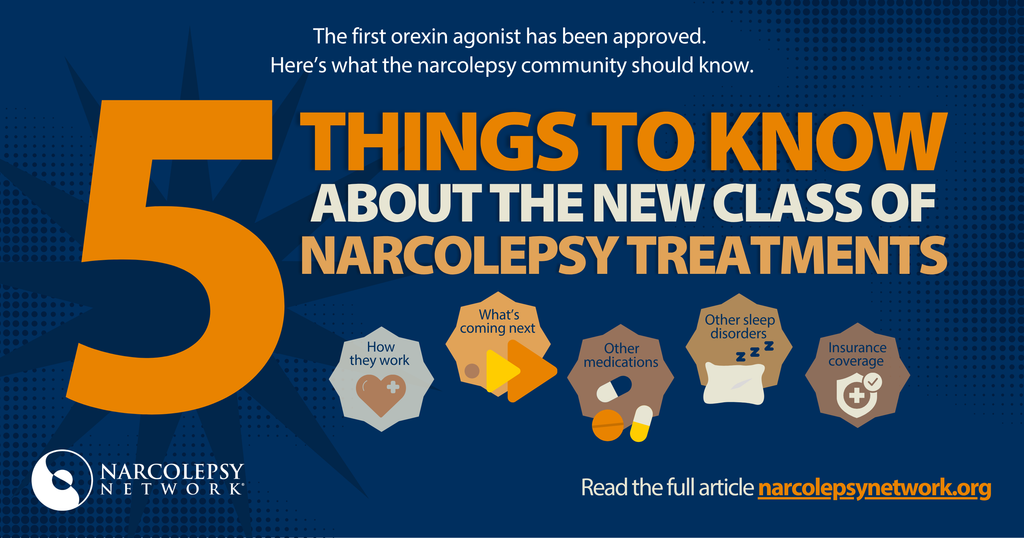
The arrival of orexin receptor agonists marks an important new chapter in narcolepsy treatment. In August 2026, the U.S. Food and Drug Administration approved ORZEYFUL™ (oveporexton), the first medication designed to directly address the loss of orexin signaling associated with narcolepsy type 1. More such treatments are on the way.
While there is considerable excitement surrounding this new class of pharmaceuticals, there are also many questions about them and what they may promise. Will these medications replace existing treatments? Could they eventually help people with narcolepsy type 2 or idiopathic hypersomnia? Will insurance cover them?
Here are five things the narcolepsy community should know.
First, what is an orexin agonist?
Orexin, also called hypocretin, is a chemical messenger produced in the brain. It helps regulate wakefulness, sleep, alertness and muscle tone.
The brains of people with narcolepsy type 1 have lost most of the cells that produce orexin. Without enough orexin, and a limited capacity to create more, these brains have difficulty maintaining stable boundaries between sleep and wakefulness. This contributes to excessive daytime sleepiness, cataplexy, disrupted nighttime sleep, sleep paralysis and hallucinations around sleep.
An agonist is a substance that activates a receptor. Orexin receptor agonists are designed to activate the same receptors that the body’s natural orexin would normally activate. In simple terms, they attempt to restore a vital signal that is missing in people with narcolepsy type 1.
1. They work in a whole new way
Current narcolepsy medications can be very helpful, but they generally manage individual symptoms through other systems in the brain. Some promote wakefulness, some reduce cataplexy and some improve nighttime sleep.
Orexin receptor agonists take a different approach. Rather than working around the loss of orexin, they instead activate orexin receptors directly. For this reason, they are often described as targeting the underlying biology of narcolepsy type 1 instead of treating only selected symptoms of the condition.
In clinical studies, ORZEYFUL improved daytime wakefulness and sleepiness while also reducing cataplexy and improving symptoms such as disrupted nighttime sleep, sleep paralysis and hallucinations. However, individual responses will vary, and no treatment can guarantee that someone will feel completely “normal” or become symptom-free.
The most commonly reported side effects of ORZEYFUL included insomnia, increased urinary frequency, urinary urgency and increased saliva production. Patients should discuss potential benefits, side effects and medication interactions with their healthcare providers.
2. ORZEYFUL is first, but other treatments should follow
ORZEYFUL, also known by its generic name oveporexton, was approved by the FDA on August 5, 2026, for adults with narcolepsy type 1. It is an oral tablet taken twice daily.
Although it has received FDA approval, ORZEYFUL is not yet available by prescription. It is awaiting scheduling by the Drug Enforcement Administration, with availability currently expected by November 2026.
Other orexin receptor agonists are moving through clinical development. These include alixorexton, formerly known as ALKS 2680, and ORX750, along with additional candidates from several pharmaceutical companies.
These investigational medications may eventually offer different dosing schedules or uses for additional sleep disorders. However, clinical development can change, and medications currently being studied are not guaranteed to receive FDA approval.
3. Nighttime medications may still be needed
One of the biggest questions is the extent to which an orexin agonist could reduce or even eliminate the need for current narcolepsy medications, including powerful sodium oxybates taken at night to regulate sleep.
ORZEYFUL was studied across a range of daytime and nighttime symptoms, and trial participants reported improvements in disrupted nighttime sleep. Still, its approval does not mean that every person who takes it will be able to discontinue oxybates, wake-promoting medications or other treatments.
Sleep researchers say some people may find that an orexin agonist addresses several of their symptoms. But narcolepsy patients, they say, may continue to need additional medication for nighttime sleep, daytime sleepiness, cataplexy or another concern. Healthcare providers will need to consider each person’s symptoms, response to treatment, side effects and overall health when developing a treatment plan.
The upshot: Do not stop or change any current medication without speaking with your healthcare provider.
4. They may work for other sleep disorders, too
ORZEYFUL is currently approved only for adults with narcolepsy type 1. Its safety and effectiveness have not been established for narcolepsy type 2 or idiopathic hypersomnia. Yet researchers are investigating the use of it and other agonists to treat those conditions.
Such broader use is considered to be less clearly beneficial, at least without further study. That’s because the loss of orexin-producing brain cells is clearly established in narcolepsy type 1. Narcolepsy type 2 and idiopathic hypersomnia are more complex, and most people with these conditions do not have the same documented orexin deficiency.
Researchers are nevertheless studying whether activating orexin receptors could improve wakefulness in people with narcolepsy type 2 and idiopathic hypersomnia. Alixorexton is being evaluated in clinical trials for both conditions, and ORX750 has been studied in people with narcolepsy type 1, narcolepsy type 2 and idiopathic hypersomnia.
These studies provide reason for hope, but it is too early to know which medications will ultimately be approved, who will benefit most or how durable those benefits will be.
5. Insurance coverage remains unclear
FDA approval does not automatically guarantee quick or affordable access to a medication. Many people with narcolepsy know that from challenges in having their insurance cover – at least quickly – very expensive oxybate medications such as Xyrem® and Lumryz™.
Because ORZEYFUL represents a new class of treatment and is not yet commercially available, patients do not yet have a clear picture of how individual insurance plans will cover it. Insurers may establish prior authorization requirements or other coverage criteria once the medication becomes available.
Coverage could become especially complicated for people whose healthcare providers recommend using an orexin agonist together with another higher-cost narcolepsy medication, such as an oxybate. An insurer may not immediately agree to cover both medications, even if a healthcare provider believes the combination is medically appropriate.
The actual cost to patients will depend on factors including insurance coverage, benefit design, eligibility for financial assistance and the treatment plan recommended by their healthcare provider.
A historic step, but not the end of the story
Orexin receptor agonists represent a major scientific advance. For the first time, an approved narcolepsy treatment can directly target the orexin signaling loss that causes narcolepsy type 1.
That makes this a time of genuine hope, but also a time for realistic expectations. The sleep community is still learning how these medications will work outside clinical trials, whether patients will continue to need other treatments, who may experience side effects and how easily people will be able to access them.
Patients should speak with a qualified sleep specialist before making any treatment decisions. Narcolepsy Network will continue advocating for access, sharing updates and elevating the questions and experiences of people living with narcolepsy and idiopathic hypersomnia.
# # #
Date Created: September 30th, 2026
Last Updated: September 30th, 2026